
THE GREENLAND CRISIS中英文版本
Updated: Jan 29
US Expansionism, European Resistance,
and the New Arctic Great Power Contest

EXECUTIVE SUMMARY
In January 2026, the Arctic became the unlikely epicenter of a transatlantic crisis that brought NATO to the brink of collapse. US President Donald Trump's escalating demands to acquire Greenland, including threats of military force, 25% tariffs on European allies, and ultimatums linking NATO support to territorial concessions, triggered the most serious rupture in the Western alliance since its founding in 1949.
The crisis, which unfolded over three weeks following the US military operation to capture Venezuelan President Nicolás Maduro, exposed fundamental tensions in the post-Cold War international order: the limits of alliance solidarity, the weaponization of economic interdependence, and the emerging great power competition for the Arctic's strategic resources and shipping lanes.
This report analyzes the drivers behind US interest in Greenland, the European response, China's Arctic ambitions, and the implications for global geopolitics. While the immediate crisis de-escalated following a "framework deal" brokered by NATO Secretary General Mark Rutte at the Davos World Economic Forum on January 21, the underlying tensions remain unresolved, and the Arctic's strategic importance will only grow as climate change opens new frontiers.
Key Facts at a Glance
Factor | Status (January 2026) |
Greenland Population | ~57,000 (mostly Inuit) |
Territory Size | World's largest island; 836,330 sq mi (80% ice-covered) |
Political Status | Autonomous territory of Denmark (Kingdom of Denmark) |
US Military Presence | Pituffik Space Base (missile warning, space surveillance) |
Rare Earth Reserves | 8th largest globally (~1.5 million tons proven) |
China's REE Dominance | 69% production, 90% processing globally |
Denmark's Annual Subsidy | ~$560 million (19% of Greenland's GDP) |
Trump's Tariff Threat | 10% (Feb 1) rising to 25% (June 1) on 8 EU countries |
Crisis Resolution | "Framework deal" at Davos (Jan 21); tariffs withdrawn |
1. THE GREENLAND CRISIS: HOW IT UNFOLDED
1.1 Historical Context
US interest in acquiring Greenland is not new. The island's strategic value has been recognized since World War II:
1867: Secretary of State William Seward (architect of the Alaska Purchase) proposes acquiring Greenland
1916: US recognizes Danish sovereignty over Greenland as condition for Virgin Islands purchase
1940-45: US establishes military presence during WWII after Germany conquers Denmark
1946: Truman administration secretly offers to buy Greenland; Denmark declines
1951: Defense of Greenland Agreement grants US extensive basing rights
2019: Trump first proposes purchasing Greenland; Danish PM calls it "absurd"
2025: Trump renews interest after re-election; appoints Jeff Landry as special envoy
1.2 January 2026 Timeline
Date | Key Events |
Jan 3 | US captures Venezuelan President Maduro; Katie Miller posts US flag over Greenland with caption "SOON" |
Jan 4 | Trump tells The Atlantic: "We do need Greenland, absolutely"; Danish PM says "stop the threats" |
Jan 6 | Joint statement from UK, France, Germany, Italy, Spain, Poland: "Greenland belongs to its people" |
Jan 7 | Trump Jr. visits Greenland; Senator Gallego introduces resolution to block invasion |
Jan 8 | Rubio confirms military force "on the table"; Denmark summons US Ambassador |
Jan 14 | White House talks with Danish/Greenlandic foreign ministers end without solution |
Jan 15-16 | Operation Arctic Endurance begins; European troops deploy to Greenland |
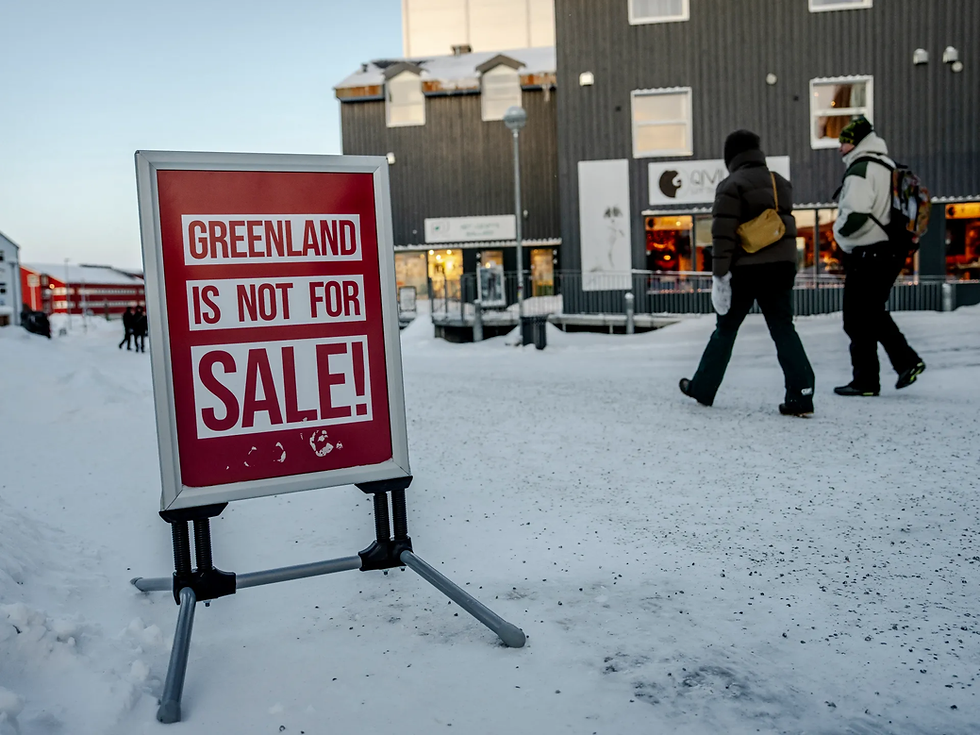
Jan 17 | Trump announces 10% tariffs on 8 European countries; quarter of Nuuk protests |
Jan 18 | EU emergency summit; €107 billion retaliation package prepared |
Jan 20 | Trump posts AI image of himself planting US flag on Greenland; posts "no going back" |
Jan 21 | Davos: Trump meets Rutte, announces "framework deal"; withdraws tariff threats; rules out force |
Jan 23 | Danish PM Frederiksen visits Greenland; EU summit demands "respect" from US |

2. WHY GREENLAND MATTERS: STRATEGIC VALUE
2.1 Military & Defense Significance
Greenland occupies a uniquely strategic position for North American and NATO defense:
Geographic Position
Located at intersection of North America, Europe, and Arctic Ocean
Guards GIUK Gap (Greenland-Iceland-UK): critical maritime chokepoint for monitoring Russian naval movements into North Atlantic
Closer to New York City (2,900 km) than to Copenhagen (3,500 km)
Northern approaches for any Russian ballistic missile attack on continental US
Existing US Military Presence
Pituffik Space Base (formerly Thule Air Base): northernmost US military installation
Functions: missile warning, missile defense, space surveillance, satellite command
Key node for Trump's proposed "Golden Dome" missile defense shield ($175 billion)
1951 Defense Agreement already allows US to expand military presence as desired
2.2 Critical Minerals & Resources
Resource | Greenland's Position | Strategic Importance |
Rare Earth Elements | 8th largest reserves (1.5M tons) | EV batteries, wind turbines, defense systems |
Uranium | Among world's largest deposits | Nuclear energy & weapons (mining banned 2021) |
Graphite | High-grade deposits (Amitsoq) | Lithium-ion battery anodes, defense |
Germanium | Extensive stores | Fiber optics, semiconductors |
Gallium | Significant deposits | Semiconductors, quantum devices |
Oil & Gas | 31-42 billion barrels (offshore) | Energy security |
However, experts caution that Greenland's mineral potential faces significant obstacles:
Harsh Arctic climate limits mining to small portion of year
Only 20% of Greenland is ice-free; temperatures reach -40°F
Minimal infrastructure: no roads, limited ports, small workforce
Low ore grades compared to existing mines (5-10x more rock to process)
Even with mining, China controls 90% of rare earth processing globally
Conservative estimates: 10+ years before meaningful production
"If you're going to go to Greenland for its minerals, you're talking billions upon billions upon billions of dollars and extremely long time before anything ever comes of it."
— Anthony Marchese, Texas Mineral Resources Corporation
2.3 Arctic Shipping Routes
Climate change is transforming Arctic accessibility:
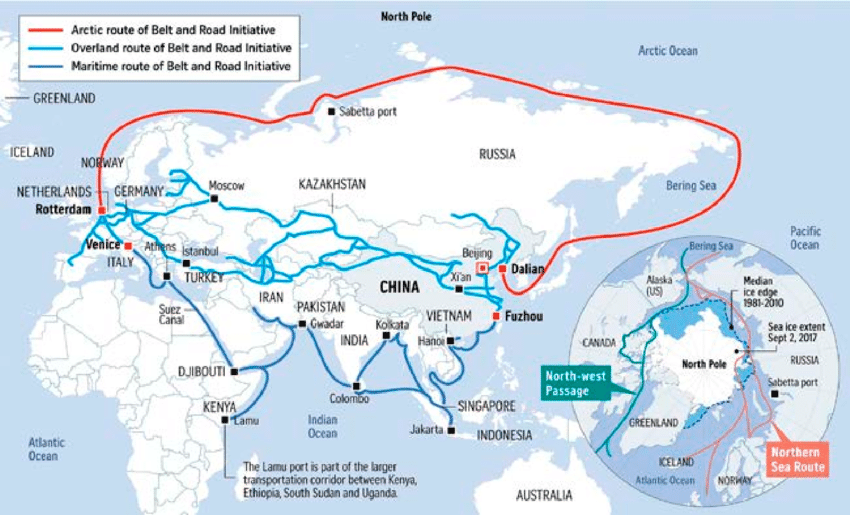
Northern Sea Route (NSR): Can cut Asia-Europe shipping time by 40% vs. Suez Canal
Russia-China cooperation on NSR development accelerating (agreements signed October 2024)
Greenland positioned as potential "strategic tollgate" for 21st-century Arctic commerce
Melting ice making previously inaccessible resources and routes viable
3. THE CHINA FACTOR: ARCTIC AMBITIONS
3.1 China's "Near-Arctic State" Strategy
Despite being 900 miles south of the Arctic Circle, China has pursued systematic Arctic engagement:
2018: Releases first Arctic Policy white paper; declares itself "Near-Arctic State"
2013: Gains observer status on Arctic Council
2018: Launches "Polar Silk Road" as extension of Belt and Road Initiative
Goal: Become "polar great power" by 2030
Chinese Investment Attempts in Greenland
2016: Attempted purchase of abandoned naval base (blocked)
2018: China Communications Construction Company wins tender for 3 airports (canceled under US pressure)
Kvanefjeld rare earth project: China's Shenghe Resources is largest shareholder in owner (Greenland Minerals)
Satellite ground station, research facilities proposed (blocked due to security concerns)
The CSIS notes: "While Beijing has yet to establish a Polar Silk Road of strategic significance, its dominance in rare earth separation and processing still gives China leverage, allowing potential access to Greenland's resources through processing and offtake agreements rather than direct ownership."
3.2 The Real Threat Assessment
Trump has repeatedly claimed Greenland is "covered with Russian and Chinese ships." Experts strongly dispute this:
"The statement by Trump that Greenland is surrounded by Russian and Chinese vessels is simply not true. It's actually quite the opposite, there's a lot more Chinese and Russian activity off the Alaska coastline."
— Malte Humpert, Arctic Institute
Danish officials have been blunt:
"I can assure you that your fantasies about a big threat from China and Russia against Greenland are delusional. You are the threat. Not them."
— Rasmus Jarlov, Chairman, Danish Defence Committee
3.3 Sino-Russian Arctic Cooperation
While not directly threatening Greenland, China-Russia Arctic cooperation is expanding:
Area | Cooperation Activities |
Shipping | Joint Northern Sea Route development; oil shipments up 25% in 2025 |
Military | Joint naval drills and bomber patrols in Bering Sea (near Alaska, not Greenland) |
Energy | Chinese stakes in Russian Arctic LNG projects |
Infrastructure | Ports, data cables, research stations (primarily Russian Arctic) |
Key distinction: Sino-Russian Arctic cooperation is concentrated in the Russian Arctic (near Russia's territory), not the Greenlandic or Canadian Arctic. Any expansion toward North America would trigger far greater NATO concern.
4. EUROPEAN RESISTANCE: STANDING FIRM
4.1 Unified European Response
The Greenland crisis produced rare European unity:
Joint Statement (January 6)
Leaders of France, Germany, UK, Italy, Spain, Poland, and Denmark issued joint statement:
"Greenland belongs to its people"
"It is for Denmark and Greenland, and them only, to decide on matters concerning Denmark and Greenland"
"Arctic security must be achieved collectively within NATO"
"Sovereignty, territorial integrity, and inviolability of borders are non-negotiable principles"
4.2 Military Response: Operation Arctic Endurance
Denmark organized multinational military exercise in Greenland with participation from:
France: Deployed troops; proposed sending additional forces
Germany: Military personnel contribution
Norway: Arctic warfare specialists
Sweden: Cold-weather troops
Netherlands: Naval and ground forces
Finland: Arctic expertise
Denmark also announced "double-digit billion" kroner increase in Greenland defense spending (between $876 million and $8.7 billion).
4.3 Economic Countermeasures Prepared
Measure | Description |
Retaliatory Tariffs | €107 billion package targeting US imports prepared |
Anti-Coercion Instrument | EU tool to restrict US suppliers' access to EU market, exclude from public tenders |
Tech Company Sanctions | Punitive measures against US tech companies considered |
Trade Deal Suspension | European Parliament delayed US-EU trade deal approval |
4.4 The Danish Position
Denmark's response was notably firm given its status as a small NATO ally:
PM Frederiksen: "We have no right to annex" territories; US should "stop the threats"
Defence Committee Chairman Jarlov: Denmark would invoke NATO Article 5 if attacked; response would include "deadly force"
Foreign Minister Rasmussen: Called Trump envoy Landry's statements "completely unacceptable"
King Frederik X: Royal speech rebuked Trump; Royal Arms modified to emphasize Greenland
The Danish position was clear: Offer everything, enhanced security cooperation, resource access, military presence, but not territory.
5. THE DAVOS RESOLUTION: FRAMEWORK DEAL

5.1 What Happened
On January 21, 2026, at the World Economic Forum in Davos:
Trump met privately with NATO Secretary General Mark Rutte
Announced "framework of a future deal" on Greenland and Arctic security
Withdrew 10% tariff threats against 8 European countries
Explicitly ruled out military force: "I don't want to use force"
Negotiations to be led by VP Vance, Secretary Rubio, Special Envoy Witkoff
5.2 What the Deal Includes (Reportedly)
Details remain sparse, but Trump indicated:
"Security" component: Enhanced NATO Arctic presence ("Arctic Sentry" similar to Baltic mission)
"Minerals" component: US and allies to receive priority access to Greenland's rare earths
Rutte to demand NATO countries "ramp up Arctic security swiftly" in early 2026
Golden Dome missile defense integration discussed
5.3 Why Trump Backed Down
Multiple factors reportedly contributed to the reversal:
European Unity: Unexpected solidarity made confrontation costly
Financial Markets: Investor jitters over potential trade war
Congressional Opposition: Bipartisan legislation (No Funds for NATO Invasion Act) limiting military options
Internal Pushback: Aides reportedly opposed invasion plan
Legal Constraints: Supreme Court case on tariff authority; NDAA limits on troop withdrawals from Europe
Military Assessment: Joint Chiefs presented unfavorable options analysis
"Former US NATO ambassador R. Nicholas Burns said Trump had clearly backed down in the face of tough military, economic and political resistance from the Europeans that the Trump administration had not calculated."
— Wikipedia, Greenland Crisis
6. GLOBAL IMPLICATIONS
6.1 For China
The Greenland crisis carries significant implications for Beijing:
Challenges
US mineral access deal may block Chinese investment in Greenland rare earths
Demonstrates US willingness to use coercive measures to counter China's resource strategy
European alignment with US on "strategic autonomy" in critical minerals
Potential model for countering Chinese infrastructure investments globally
Opportunities
US-Europe tensions create diplomatic opening for Beijing
Trump's behavior validates Chinese narrative of US "hegemony" and unreliability
BRICS and Global South may see US as destabilizing force
European desire for "diversification" could include China engagement
6.2 For NATO
Damage | Mitigation |
Trust: US threatened force against ally for first time | Alliance held together; Article 5 credibility tested but preserved |
Cohesion: Trump linked Ukraine support to Greenland | European unity demonstrated; deterrence capability proven |
Purpose: "What is NATO for if US can annex allies?" | Framework deal on Arctic security gives NATO new mission |
Credibility: US unpredictability exposed | Europe accelerating defense independence (€107B package ready) |
6.3 For the Rules-Based International Order
The crisis exposed fundamental tensions:
Territorial Integrity: US president openly contemplated annexing NATO ally's territory
Economic Coercion: Tariffs used as geopolitical weapon against allies
Alliance Obligations: NATO's collective defense promise questioned
Precedent: Trump cited UK's Chagos Islands transfer as justification
Power vs. Rules: Raw power projection vs. international law norms
The Atlantic Council's assessment: "Trump's behavior during 2025 and 2026 was described as having damaged the US standing in the world and how allies see the US in the long term."
7. SCENARIO ANALYSIS: WHAT COMES NEXT?
Scenario 1: Framework Implementation
The Davos deal evolves into genuine Arctic security cooperation.
NATO establishes "Arctic Sentry" mission in Greenland
US gains enhanced military access and mineral rights without sovereignty
Denmark/Greenland receive investment and security guarantees
China effectively blocked from Greenland resource sector
Transatlantic relations gradually normalize
Scenario 2: Renewed Tensions
Trump returns to acquisition demands as political circumstances change.
Greenland independence referendum accelerates; US sees opening
China makes new investment overtures, triggering US response
Tariff threats renewed over unrelated trade disputes
European defense buildup continues regardless
Arctic becomes permanent flashpoint in US-Europe relations
Scenario 3: Greenland Independence Pathway
Crisis accelerates Greenland's path to full independence from Denmark.
Greenland holds independence referendum (draft constitution already exists)
Independent Greenland negotiates bilateral arrangements with US, EU, China
US achieves strategic objectives through partnership rather than acquisition
Denmark loses formal control but maintains close ties
New Arctic power dynamics emerge
Scenario 4: Arctic Militarization
Great power competition escalates into sustained Arctic confrontation.
Russia responds to NATO Arctic buildup with own military expansion
China increases Arctic naval presence in partnership with Russia
Arms race dynamics develop in previously cooperative region
Arctic Council breaks down; regional governance collapses
Risk of accidental conflict increases significantly
8. CONCLUSION
The Greenland crisis of January 2026 will be remembered as a watershed moment in transatlantic relations, the first time a US president openly threatened to annex the territory of a NATO ally. While the immediate confrontation was defused at Davos, the underlying dynamics that produced it remain in place.
The Arctic is becoming a new frontier of great power competition. Climate change is opening previously inaccessible shipping routes and resources. China is positioning itself as a "near-Arctic state" with global ambitions. Russia is militarizing its Arctic territory. And the United States, under Trump, has signaled that it views Greenland as vital to homeland defense, with or without allied consent.
For Europe, the crisis delivered a sobering lesson: American security guarantees cannot be taken for granted. The EU's response, unity, military deployment, economic countermeasures, proved effective this time. But the structural mismatch between European dependence on US security and American unpredictability remains unresolved.
For China, the crisis presents both challenges and opportunities. US determination to block Chinese access to Arctic resources is now explicit. But American coercion of allies also validates Beijing's narrative of US hegemony and creates diplomatic openings with partners seeking alternatives.
Key Takeaways
The Arctic is now a theater of great power competition, expect continued tensions
US desire for Greenland control will not disappear regardless of framework deals
European defense autonomy will accelerate in response to alliance uncertainty
China's Arctic ambitions are real but constrained by Western countermeasures
Greenland's path to independence may accelerate, reshaping Arctic governance
Critical minerals supply chains remain vulnerable to geopolitical disruption
What to Watch
Framework deal implementation: Will NATO "Arctic Sentry" mission materialize?
Greenland's April 2025 election aftermath: Independence sentiment and US relations
Chinese rare earth investment attempts: Will Beijing find alternative pathways?
US domestic politics: Congressional constraints on executive action
Trump's next move: Panama Canal, Canada also mentioned as targets
SOURCES & REFERENCES
News & Current Reporting
Strategic Analysis
Reference Sources
格陵兰危机
美国扩张主义、欧洲抵抗
与北极大国竞争新格局
执行摘要
2026年1月,北极意外成为一场跨大西洋危机的中心,这场危机几乎使北约濒临崩溃。美国总统唐纳德·特朗普不断升级对格陵兰的收购要求, 包括威胁使用武力、对欧洲盟友征收25%关税,以及将北约支持与领土让步挂钩, 引发了自1949年北约成立以来西方联盟最严重的裂痕。
这场危机发生在美国军事行动俘获委内瑞拉总统尼古拉斯·马杜罗之后的三周内,暴露了冷战后国际秩序的根本性紧张:联盟团结的局限、经济相互依赖的武器化,以及北极战略资源和航运通道日益激烈的大国竞争。
本报告分析美国对格陵兰兴趣的驱动因素、欧洲的回应、中国的北极野心,以及对全球地缘政治的影响。虽然1月21日北约秘书长马克·吕特在达沃斯世界经济论坛上促成的「框架协议」缓和了直接对抗,但潜在的紧张关系依然存在, 随着气候变化开辟新疆域,北极的战略重要性只会继续增长。
核心数据一览
要素 | 状态(2026年1月) |
格陵兰人口 | 约57,000人(主要为因纽特人) |
领土面积 | 世界最大岛屿;216万平方公里(80%被冰覆盖) |
政治地位 | 丹麦自治领土(丹麦王国) |
美军驻扎 | 皮图菲克太空基地(导弹预警、太空监视) |
稀土储量 | 全球第8位(约150万吨已探明储量) |
中国稀土主导地位 | 全球生产占69%,加工占90% |
丹麦年度补贴 | 约5.6亿美元(占格陵兰GDP的19%) |
特朗普关税威胁 | 10%(2月1日起)升至25%(6月1日)针对8个欧盟国家 |
危机解决 | 达沃斯「框架协议」(1月21日);关税撤回 |
一、格陵兰危机:事件经过
1.1 历史背景
美国对收购格陵兰的兴趣由来已久。该岛的战略价值自二战以来便得到认可:
1867年:国务卿威廉·西沃德(阿拉斯加购买案设计者)提议收购格陵兰
1916年:美国承认丹麦对格陵兰的主权,作为购买维尔京群岛的条件
1940-45年:德国占领丹麦后,美国在二战期间建立军事存在
1946年:杜鲁门政府秘密提出购买格陵兰;丹麦拒绝
1951年:《格陵兰防务协定》授予美国广泛的驻军权
2019年:特朗普首次提议购买格陵兰;丹麦首相称之「荒谬」
2025年:特朗普连任后重燃兴趣;任命杰夫·兰德里为特使
1.2 2026年1月时间线
日期 | 关键事件 |
1月3日 | 美军俘获委内瑞拉总统马杜罗;凯蒂·米勒发布美国国旗覆盖格陵兰图片,配文「即将」 |
1月4日 | 特朗普告诉《大西洋》杂志:「我们确实需要格陵兰」;丹麦首相呼吁「停止威胁」 |
1月6日 | 英法德意西波兰领导人联合声明:「格陵兰属于其人民」 |
1月7日 | 小特朗普访问格陵兰;参议员加列戈提出决议阻止入侵 |
1月8日 | 鲁比奥确认军事力量「在选项之中」;丹麦召见美国大使 |
1月14日 | 白宫与丹麦/格陵兰外长会谈未达成解决方案 |
1月15-16日 | 「北极持久」军事演习开始;欧洲军队部署至格陵兰 |
1月17日 | 特朗普宣布对8个欧洲国家征收10%关税;努克四分之一人口抗议 |
1月18日 | 欧盟紧急峰会;准备1070亿欧元报复方案 |
1月20日 | 特朗普发布AI生成的自己在格陵兰插旗图片;称「没有回头路」 |
1月21日 | 达沃斯:特朗普会见吕特,宣布「框架协议」;撤回关税威胁;排除武力选项 |
1月23日 | 丹麦首相弗雷泽里克森访问格陵兰;欧盟峰会要求美国「尊重」 |
二、格陵兰的重要性:战略价值
2.1 军事与国防意义
格陵兰在北美和北约防御中占据独特的战略位置:
地理位置
位于北美、欧洲和北冰洋的交汇点
扼守GIUK缺口(格陵兰-冰岛-英国):监控俄罗斯海军进入北大西洋的关键海上咽喉
距纽约市(2,900公里)比距哥本哈根(3,500公里)更近
任何俄罗斯对美国本土的弹道导弹攻击的北方通道
美国现有军事存在
皮图菲克太空基地(原图勒空军基地):美国最北端军事设施
功能:导弹预警、导弹防御、太空监视、卫星指挥
特朗普提议的「金穹」导弹防御系统(1750亿美元)的关键节点
1951年《防务协定》已允许美国按需扩大军事存在
2.2 关键矿产与资源
资源 | 格陵兰的地位 | 战略重要性 |
稀土元素 | 储量全球第8位(150万吨) | 电动汽车电池、风力发电机、国防系统 |
铀 | 世界最大矿藏之一 | 核能与核武器(2021年禁止开采) |
石墨 | 高品位矿藏(阿米索克) | 锂离子电池阳极、国防 |
锗 | 储量丰富 | 光纤、半导体 |
镓 | 储量可观 | 半导体、量子设备 |
油气 | 310-420亿桶(海上) | 能源安全 |
然而,专家警告格陵兰的矿产潜力面临重大障碍:
严酷的北极气候限制了开采时间
仅20%的格陵兰无冰覆盖;温度可达-40°C
基础设施极少:无公路、港口有限、劳动力不足
矿石品位低于现有矿山(需处理5-10倍的岩石量)
即使开采成功,中国仍控制全球90%的稀土加工能力
保守估计:10年以上才能实现有意义的产出
「如果你打算去格陵兰开采矿产,需要投入数千亿美元,而且要等很长很长时间才能有任何产出。」
——安东尼·马尔凯塞,德克萨斯矿产资源公司
2.3 北极航运通道
气候变化正在改变北极的可达性:
北方海航线:可将亚欧航运时间缩短40%(相比苏伊士运河)
俄中合作开发北方海航线加速推进(2024年10月签署协议)
格陵兰可能成为21世纪北极商业的「战略关卡」
冰层融化使此前无法进入的资源和航线变得可行
三、中国因素:北极野心
3.1 中国的「近北极国家」战略
尽管距北极圈900英里,中国仍在系统性地推进北极参与:
2018年:发布首份北极政策白皮书;自称「近北极国家」
2013年:获得北极理事会观察员地位
2018年:推出「冰上丝绸之路」作为「一带一路」延伸
目标:2030年成为「极地强国」
中国在格陵兰的投资尝试
2016年:试图购买废弃海军基地(被阻止)
2018年:中国交通建设公司中标3个机场项目(在美国压力下取消)
克瓦内菲尔德稀土项目:中国盛和资源是所有者(格陵兰矿业公司)的最大股东
卫星地面站、研究设施提案(因安全担忧被阻止)
CSIS指出:「虽然北京尚未建立具有战略意义的极地丝绸之路,但其在稀土分离和加工方面的主导地位仍使中国具有杠杆作用,可通过加工和承购协议而非直接所有权获取格陵兰的资源。」
3.2 真实威胁评估
特朗普多次声称格陵兰「到处都是俄罗斯和中国的船只」。专家对此强烈质疑:
「特朗普所说的格陵兰被俄罗斯和中国船只包围根本不是事实。实际情况恰恰相反—,在阿拉斯加海岸线附近有更多的中俄活动。」
——马尔特·胡珀特,北极研究所
丹麦官员直言不讳:
「我可以向你保证,你关于中国和俄罗斯对格陵兰构成重大威胁的幻想是妄想。你才是威胁。不是他们。」
——拉斯穆斯·雅尔洛夫,丹麦国防委员会主席
3.3 中俄北极合作
虽然并未直接威胁格陵兰,但中俄北极合作正在扩大:
领域 | 合作活动 |
航运 | 联合开发北方海航线;2025年石油运输量增长25% |
军事 | 白令海联合海军演习和轰炸机巡逻(靠近阿拉斯加,非格陵兰) |
能源 | 中国持有俄罗斯北极LNG项目股份 |
基础设施 | 港口、数据电缆、研究站(主要在俄罗斯北极地区) |
关键区别:中俄北极合作集中在俄罗斯北极地区(靠近俄罗斯领土),而非格陵兰或加拿大北极地区。任何向北美扩展的举动都会引发北约的高度关注。
四、欧洲抵抗:坚定立场
4.1 统一的欧洲回应
格陵兰危机产生了罕见的欧洲团结:
联合声明(1月6日)
法国、德国、英国、意大利、西班牙、波兰和丹麦领导人发表联合声明:
「格陵兰属于其人民」
「丹麦和格陵兰,且仅有他们,才能决定涉及丹麦和格陵兰的事务」
「北极安全必须在北约框架内集体实现」
「主权、领土完整和边界不可侵犯是不可谈判的原则」
4.2 军事回应:北极持久行动
丹麦组织多国军事演习,参与国包括:
法国:部署军队;提议增派兵力
德国:军事人员贡献
挪威:北极战争专家
瑞典:寒冷天气部队
荷兰:海军和地面部队
芬兰:北极专业知识
丹麦还宣布增加「两位数十亿」克朗的格陵兰国防开支(8.76亿至87亿美元之间)。
4.3 准备的经济反制措施
措施 | 说明 |
报复性关税 | 准备1070亿欧元针对美国进口的方案 |
反胁迫工具 | 欧盟工具:限制美国供应商进入欧盟市场、排除其参与公共采购 |
科技公司制裁 | 考虑对美国科技公司采取惩罚措施 |
贸易协议暂停 | 欧洲议会推迟美欧贸易协议审批 |
4.4 丹麦立场
作为北约小盟国,丹麦的回应异常坚定:
首相弗雷泽里克森:「我们无权吞并」领土;美国应「停止威胁」
国防委员会主席雅尔洛夫:若遭攻击丹麦将援引北约第5条;回应将包括「致命武力」
外交大臣拉斯穆森:称特朗普特使兰德里的言论「完全不可接受」
弗雷德里克十世国王:皇家演讲谴责特朗普;皇家纹章修改以强调格陵兰
丹麦的立场很明确:提供一切—,加强安全合作、资源准入、军事存在—,但不包括领土。
五、达沃斯解决方案:框架协议
5.1 发生了什么
2026年1月21日,在达沃斯世界经济论坛上:
特朗普与北约秘书长马克·吕特私下会面
宣布关于格陵兰和北极安全的「未来协议框架」
撤回对8个欧洲国家的10%关税威胁
明确排除军事手段:「我不想使用武力」
谈判将由副总统万斯、国务卿鲁比奥、特使维特科夫主导
5.2 协议内容(据报道)
细节仍然稀少,但特朗普表示:
「安全」组成部分:加强北约北极存在(类似波罗的海任务的「北极哨兵」)
「矿产」组成部分:美国及盟友优先获取格陵兰稀土
吕特要求北约国家在2026年初「迅速加强北极安全」
讨论「金穹」导弹防御整合
5.3 特朗普为何退让
据报道,多重因素促成了这一逆转:
欧洲团结:意外的团结使对抗代价高昂
金融市场:投资者对潜在贸易战感到不安
国会反对:两党立法(《禁止资助北约入侵法案》)限制军事选项
内部阻力:据报道助手反对入侵计划
法律约束:关税权力的最高法院案件;《国防授权法案》限制从欧洲撤军
军事评估:参谋长联席会议主席提交的选项分析不利
「前美国驻北约大使R·尼古拉斯·伯恩斯表示,特朗普明显在欧洲人强硬的军事、经济和政治抵抗面前退让了,而特朗普政府此前并未预料到这种抵抗。」
——维基百科,格陵兰危机
六、全球影响
6.1 对中国的影响
格陵兰危机对北京具有重大影响:
挑战
美国矿产准入协议可能阻止中国在格陵兰稀土领域的投资
展示美国愿意使用强制手段对抗中国的资源战略
欧洲在关键矿产「战略自主」问题上与美国结盟
可能成为全球范围内对抗中国基础设施投资的模板
机遇
美欧紧张关系为北京创造外交开口
特朗普的行为印证了中国关于美国「霸权主义」和不可靠性的叙事
金砖国家和全球南方可能视美国为不稳定力量
欧洲对「多元化」的渴望可能包括与中国接触
6.2 对北约的影响
损害 | 缓解 |
信任:美国首次威胁对盟友使用武力 | 联盟团结一致;第5条可信度经受考验但得以保持 |
凝聚力:特朗普将乌克兰支持与格陵兰挂钩 | 欧洲团结得到展示;威慑能力得到证明 |
目的:「如果美国可以吞并盟友,北约存在的意义是什么?」 | 北极安全框架协议赋予北约新使命 |
信誉:美国的不可预测性暴露无遗 | 欧洲加速防务独立(1070亿欧元方案已准备就绪) |
6.3 对基于规则的国际秩序的影响
这场危机暴露了根本性紧张:
领土完整:美国总统公开考虑吞并北约盟友的领土
经济胁迫:关税被用作针对盟友的地缘政治武器
同盟义务:北约集体防御承诺受到质疑
先例:特朗普引用英国移交查戈斯群岛作为理由
实力与规则:原始实力投射与国际法规范的对抗
大西洋理事会的评估:「特朗普在2025年和2026年的行为被认为损害了美国在世界上的地位,以及盟友长期如何看待美国。」
七、情景分析:未来走向
情景一:框架协议落实
达沃斯协议演变为真正的北极安全合作。
北约在格陵兰建立「北极哨兵」任务
美国在不获得主权的情况下获得增强的军事准入和矿产权
丹麦/格陵兰获得投资和安全保障
中国被有效阻止进入格陵兰资源领域
跨大西洋关系逐步正常化
情景二:紧张关系重燃
随着政治形势变化,特朗普重新提出收购要求。
格陵兰独立公投加速;美国看到机会
中国提出新的投资提议,引发美国回应
因不相关的贸易争端重新发出关税威胁
无论如何欧洲防务建设继续推进
北极成为美欧关系的长期摩擦点
情景三:格陵兰独立路径
危机加速格陵兰脱离丹麦实现完全独立的进程。
格陵兰举行独立公投(宪法草案已存在)
独立的格陵兰与美国、欧盟、中国谈判双边安排
美国通过伙伴关系而非收购实现战略目标
丹麦失去正式控制但保持密切关系
新的北极权力格局形成
情景四:北极军事化
大国竞争升级为持续的北极对抗。
俄罗斯以自身军事扩张回应北约北极建设
中国与俄罗斯合作增加北极海军存在
此前合作的地区出现军备竞赛态势
北极理事会崩溃;地区治理瓦解
意外冲突风险显著增加
八、结论
2026年1月的格陵兰危机将被铭记为跨大西洋关系的分水岭——美国总统首次公开威胁吞并北约盟友的领土。虽然直接对抗在达沃斯得到缓解,但产生危机的根本性态势依然存在。
北极正成为大国竞争的新前沿。气候变化正在开辟此前无法进入的航运通道和资源。中国正将自己定位为具有全球野心的「近北极国家」。俄罗斯正在其北极领土军事化。而特朗普领导下的美国已发出信号:无论是否经盟友同意,它都视格陵兰为国土防御的关键。
对欧洲而言,这场危机带来了发人深省的教训:美国的安全保障不能被视为理所当然。欧盟的回应——团结、军事部署、经济反制措施——这次证明是有效的。但欧洲对美国安全的依赖与美国不可预测性之间的结构性不匹配仍未解决。
对中国而言,这场危机既带来挑战也带来机遇。美国阻止中国获取北极资源的决心现已明确。但美国对盟友的胁迫也印证了北京关于美国霸权的叙事,并为寻求替代选择的伙伴创造了外交开口。
关键要点
北极现已成为大国竞争的舞台——预计紧张关系将持续
无论框架协议如何,美国对格陵兰控制的渴望不会消失
欧洲防务自主将因联盟不确定性而加速
中国的北极野心是真实的,但受到西方反制措施的限制
格陵兰的独立进程可能加速,重塑北极治理
关键矿产供应链仍易受地缘政治干扰
值得关注的动向
框架协议落实情况:北约「北极哨兵」任务能否实现?
格陵兰2025年4月选举后续:独立情绪和美国关系
中国稀土投资尝试:北京能否找到替代路径?
美国国内政治:国会对行政行动的限制
特朗普的下一步动作:巴拿马运河、加拿大也被提及为目标



Comments